A veterinary anaesthesia machine is the most critical piece of life-support equipment in your procedure room. Choosing the wrong one — or buying on price alone — has real clinical consequences. This guide covers the five questions to answer before signing a purchase order.
1. Rebreathing vs non-rebreathing circuit
The circuit type sets the design of almost everything else in the machine.
- Rebreathing (circle) systems absorb exhaled CO₂ via a soda-lime canister, recirculate warmed, humidified gas, and deliver precise inhalant concentrations. They are the standard for patients above 5–7 kg and for longer procedures.
- Non-rebreathing systems (Bain, Mapleson F) use high fresh-gas flows to flush expired CO₂ and are better suited to patients under 5 kg — avian, exotic, and neonatal cases — where the dead space and resistance of a circle system is prohibitive.
Most mixed-practice anaesthesia machines ship with a circle system and provisions for a non-rebreathing attachment. Verify both are available before purchase if your clinic handles small exotics alongside routine canine and feline surgery.
2. Vaporiser type and agent
Isoflurane remains the standard inhalant agent in Southeast Asia for cost and availability reasons. Sevoflurane is preferred in human paediatric practice and is increasingly used in feline and avian work. Confirm that your machine accepts a precision vaporiser calibrated to the agent you use — do not mix vaporisers and agents.
Variable-bypass precision vaporisers (VBPs) compensate for changes in ambient temperature and fresh-gas flow rate, maintaining consistent delivered concentration across the full working range. This is mandatory for clinical use — agent-specific, VBP vaporisers should not be substituted with simpler devices.
3. Breathing circuit size
Most table-top units ship with an adult circle (3 L rebreathing bag, 22 mm diameter tubing). If your practice includes paediatric patients or cats routinely, check whether the manufacturer offers a paediatric circle (1 L bag, 15 mm tubing) as an add-on — the smaller dead space and resistance matter for patients under 4 kg.
4. Integrated monitoring vs stand-alone
Modern anaesthesia workstations bundle SpO₂, NIBP, ECG and capnography into a single unit. Simpler table-top machines leave monitoring to stand-alone monitors. There is no clinical right answer, but bundled systems simplify setup, cabling and documentation — especially for smaller teams running high-volume surgical schedules.
5. Oxygen source and flowmeter range
Confirm the machine accepts either compressed oxygen cylinders (E-size or H-size, depending on your clinic’s storage) or a pipeline supply from an on-site oxygen concentrator. Flowmeter range matters: the typical 0–3 L/min range is adequate for most canine patients but inadequate for equine use. For mixed large-animal practice, look for a 0–10 L/min flowmeter.
Which machine fits your case-mix?
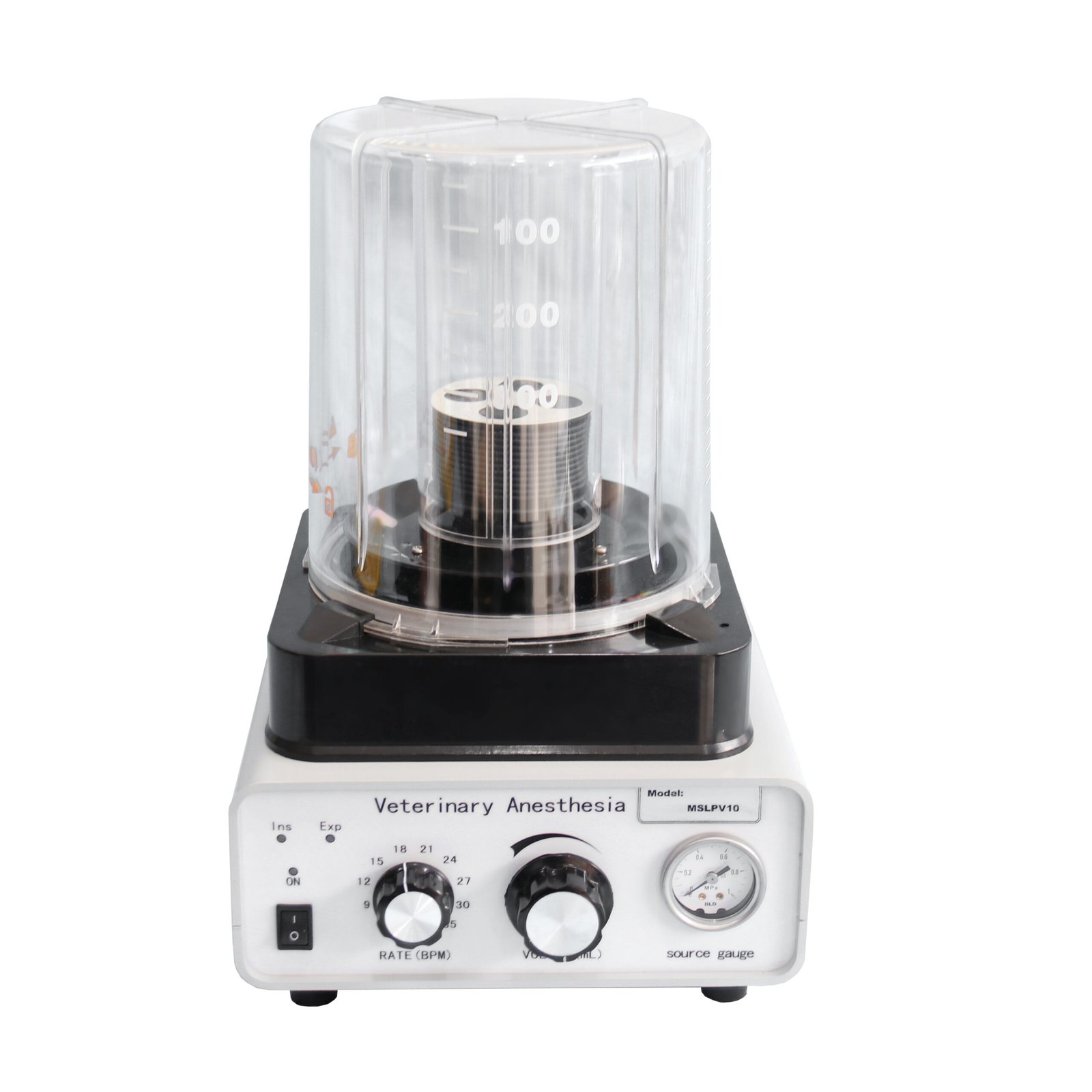
LumaVet stocks the IWA-ANE101 compact table-top anaesthesia machine for small-animal practice and the IWA-ANE200 for clinics requiring a larger circuit and expanded fresh-gas flow range. Both accept standard isoflurane precision vaporisers and include a rebreathing circle system with soda-lime canister.
If you’re running more than 10 anaesthetics per week or handling feline-heavy caseloads, contact us to discuss a paediatric circuit upgrade and integrated monitoring options.
Looking for veterinary equipment in Thailand? Browse our full lineup at lumavet.com or contact our team at sales@lumavet.com.