
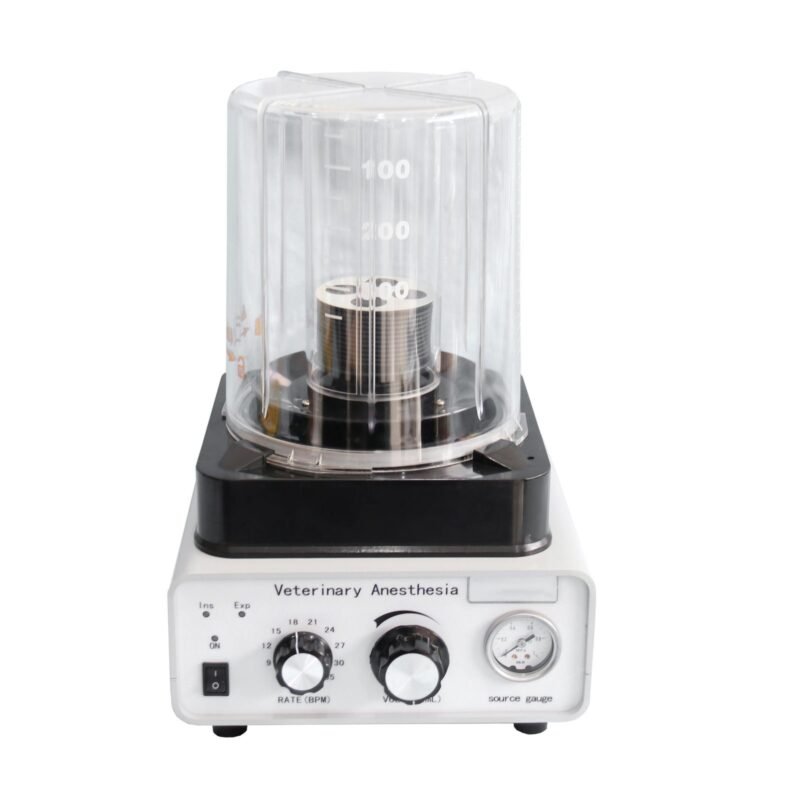



Pneumatically driven bellows ventilator for veterinary anaesthesia, with a dual-scale bellows covering exotic through large canine patients.
Product Overview
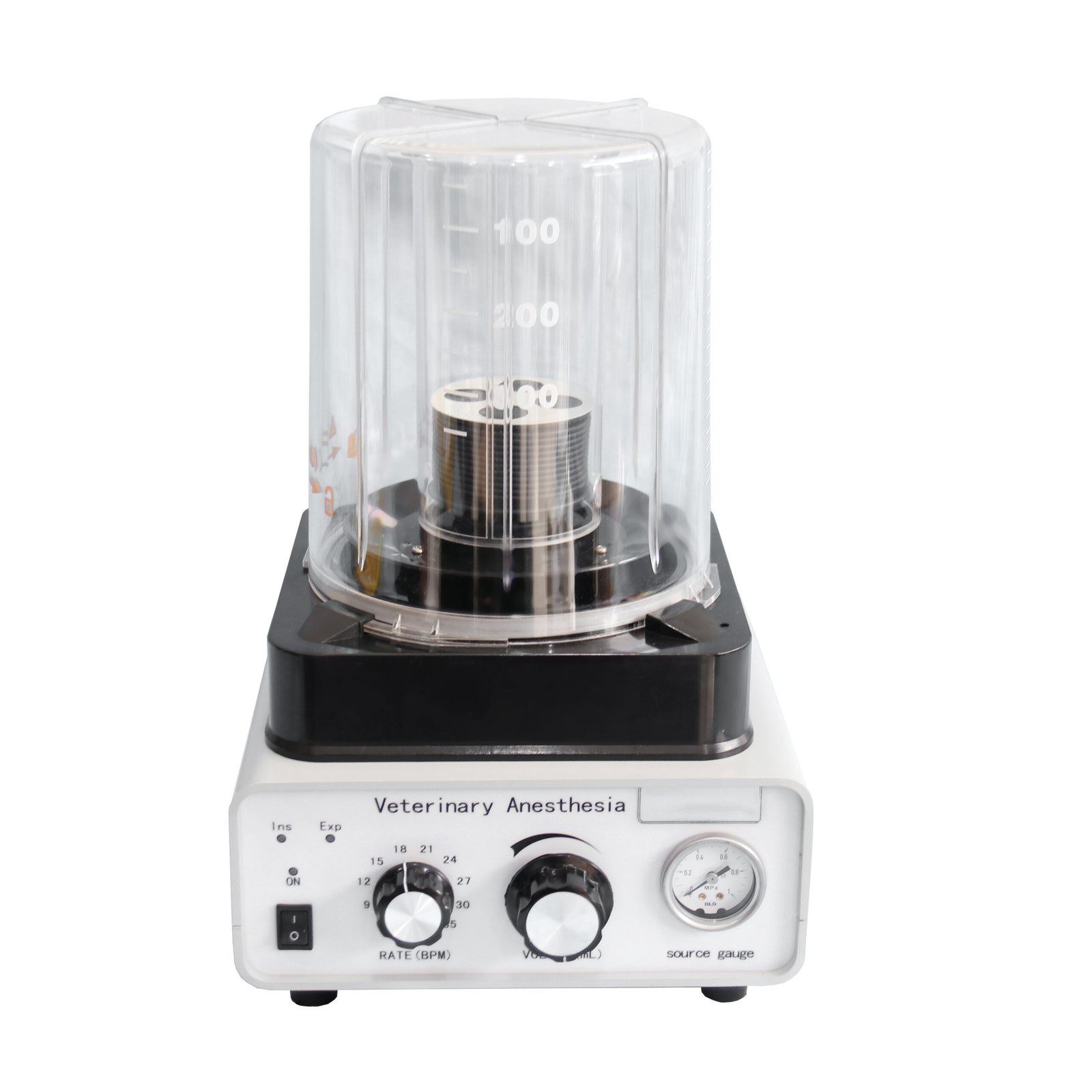
The VA60 is a pneumatically driven bellows ventilator for use with a veterinary anaesthesia machine. Driving gas compresses the bellows inside its canister; the patient gas stays in the breathing system, so the ventilator does not add fresh gas to the circuit.
Rate and tidal volume are set on two dials, and delivered volume is read directly off the bellows. The canister carries two scales — a fine inner scale for small patients and a coarse outer scale for large ones — so the same unit covers exotic through large canine work without changing the bellows.
Key Features
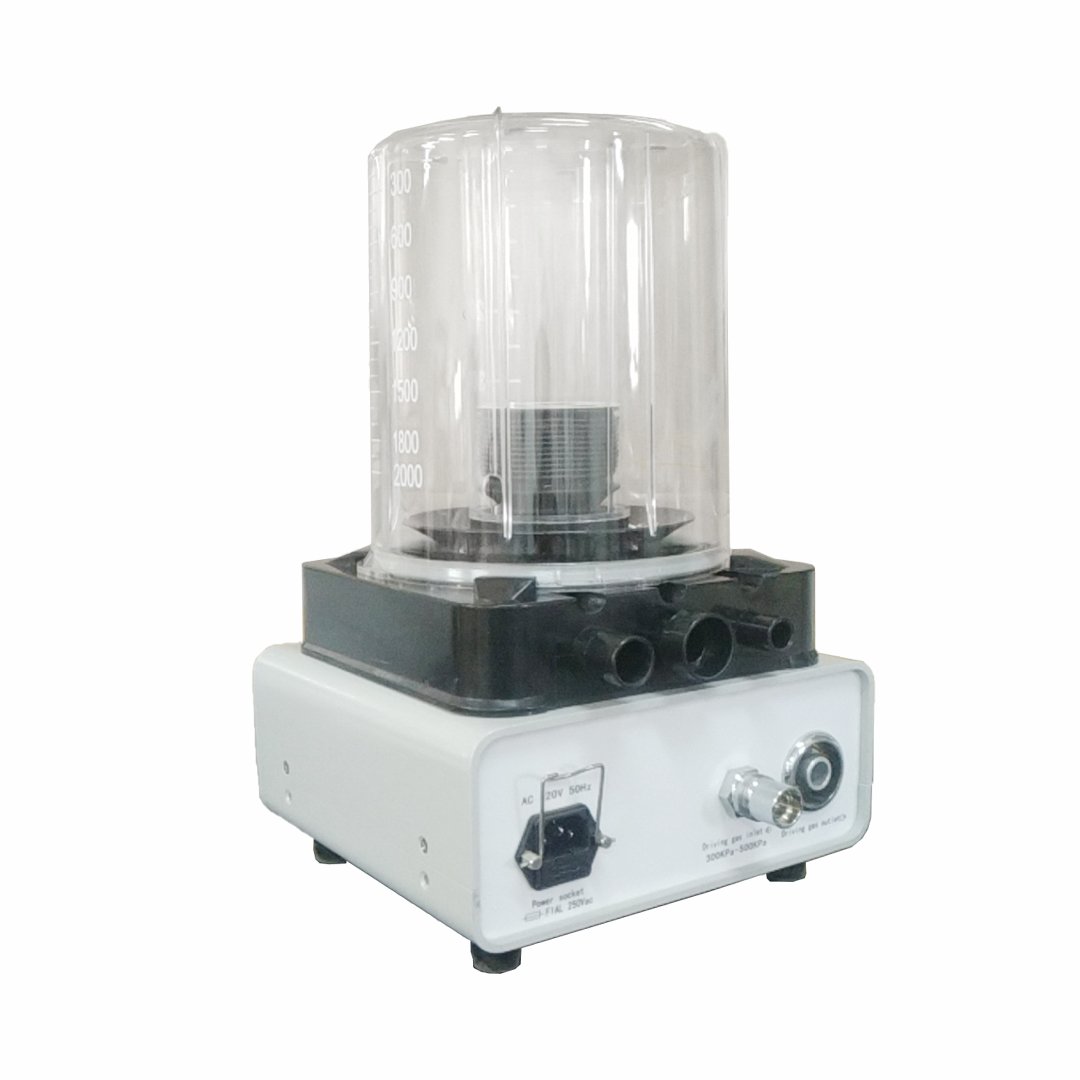
- Dual-scale bellows — 100, 200 and 300 mL graduations on the inner scale; 300 to 2000 mL on the outer scale
- Delivered volume read directly off the bellows travel, not inferred from a setting
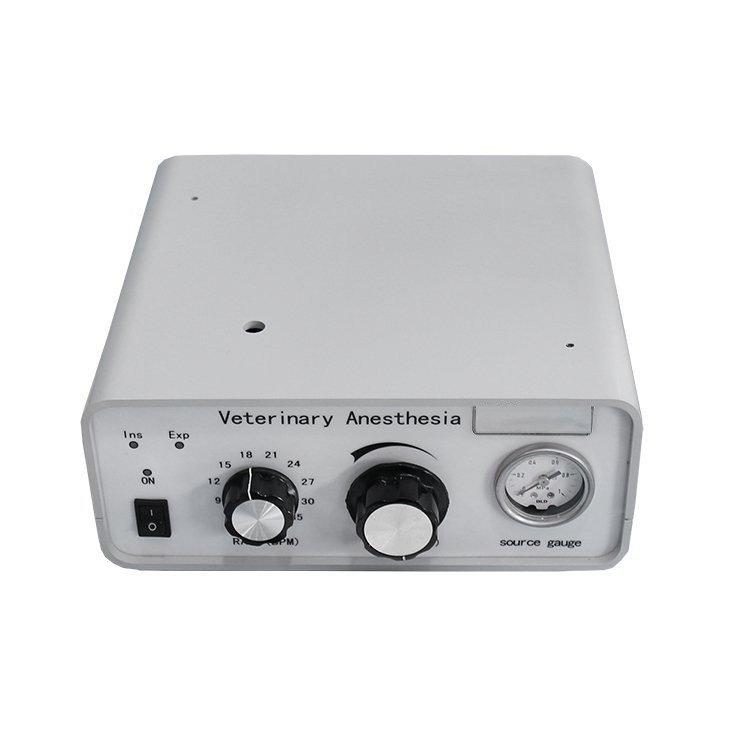
- Respiratory rate dial graduated 9 to 33 breaths per minute
- Separate tidal volume dial, calibrated in millilitres
- Driving gas source gauge on the front panel, 0 to 1 MPa
- Inspiration and expiration indicators show the cycle at a glance from across the theatre
- Pneumatic drive — the driving gas is separated from the patient breathing system
- Driving gas inlet rated 300 to 500 kPa, with a dedicated outlet port
- Bench-standing base with a single rocker power switch — no start-up sequence
Visual Evidence

Technical Specifications
| Model | VA60 |
| Type | Pneumatically driven bellows ventilator for veterinary anaesthesia |
| Bellows graduation | Inner scale 100 / 200 / 300 mL; outer scale 300–2000 mL |
| Respiratory rate | Dial graduated 9–33 breaths per minute |
| Tidal volume control | Dedicated dial, calibrated in mL |
| Driving gas inlet pressure | 300–500 kPa |
| Source pressure gauge | 0–1 MPa, front panel |
| Cycle indication | Inspiration and expiration indicator lamps |
| Power supply | AC 220 V, 50 Hz; fuse F1AL 250 Vac |
| Tidal volume setting range | [TBC] |
| I:E ratio | [TBC] |
| Airway pressure limit | [TBC] |
| Alarms | [TBC] |
| Dimensions / weight | [TBC] |
Clinical Applications
- Controlled ventilation during inhalant anaesthesia in canine and feline patients
- Procedures where spontaneous ventilation is unreliable — thoracic surgery, deep planes, prolonged orthopaedic work
- Patients requiring ventilatory support under neuromuscular blockade
- Small and exotic patients, using the fine inner bellows scale
- Large canine patients, using the 300–2000 mL outer scale
Workflow & Installation Notes
- Requires a driving gas supply at 300–500 kPa. Confirm the supply and regulator before installation — pressure outside this band is the most common commissioning fault
- Mains supply is marked AC 220 V, 50 Hz. Check the local supply before ordering
- Connects into the breathing system in place of the reservoir bag; driving gas stays separated from patient gas
- Set the rate first, then adjust tidal volume and confirm the delivered volume against the bellows scale rather than the dial alone
- Read small-patient volumes on the inner scale; the outer scale is too coarse below 300 mL
Package Contents
Downloads & Documentation
Why Choose VA60
- One bellows covers exotic through large canine — no second ventilator and no bellows swap between cases
- Delivered volume is read off the bellows, so the number on the canister is the volume the patient received
- Pneumatic drive keeps driving gas out of the breathing system
- Two dials and a rocker switch — nothing to configure between patients
Warranty & Support
FAQ
What driving gas pressure does it need? The inlet is rated 300–500 kPa. Check the regulator output before installation.
Does the driving gas reach the patient? No. The bellows separates driving gas from the patient breathing system; driving gas compresses the bellows from outside.
Can it ventilate a cat or a rabbit? The inner bellows scale is graduated at 100, 200 and 300 mL for small-patient volumes. For the lowest deliverable volume, confirm the tidal volume setting range with us before ordering.
What mains supply does it take? The rear panel is marked AC 220 V, 50 Hz with an F1AL 250 Vac fuse. Confirm your local supply before ordering.
How is it connected to the anaesthesia machine? It replaces the reservoir bag in the breathing system. Rate and tidal volume are then set on the ventilator rather than delivered by hand.
admin –
Sit amet venenatis urna cursus eget nunc scelerisque viverra mauris. Eu non diam phasellus vestibulum lorem sed.