
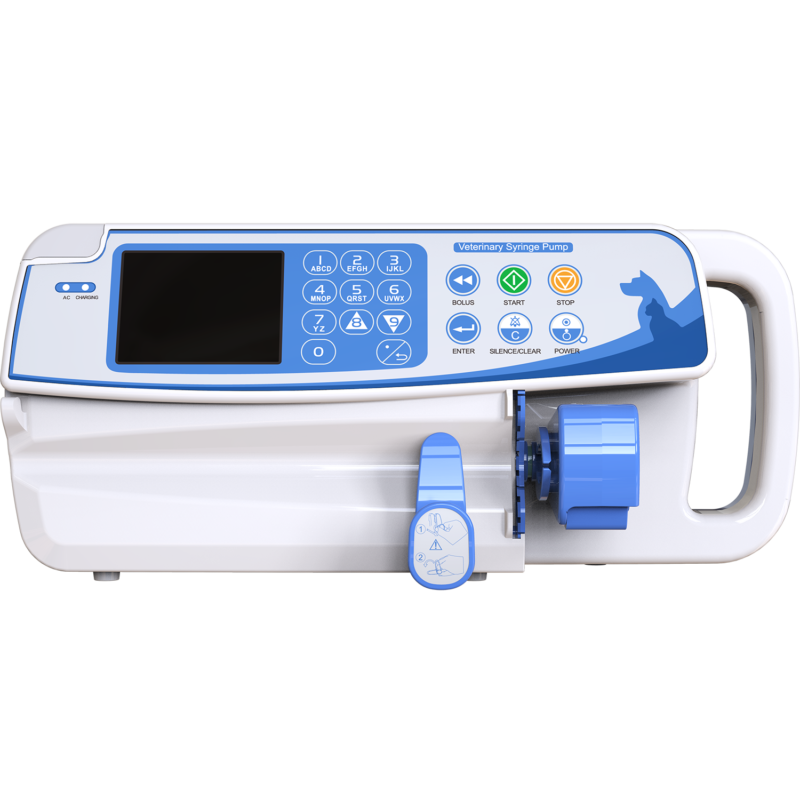
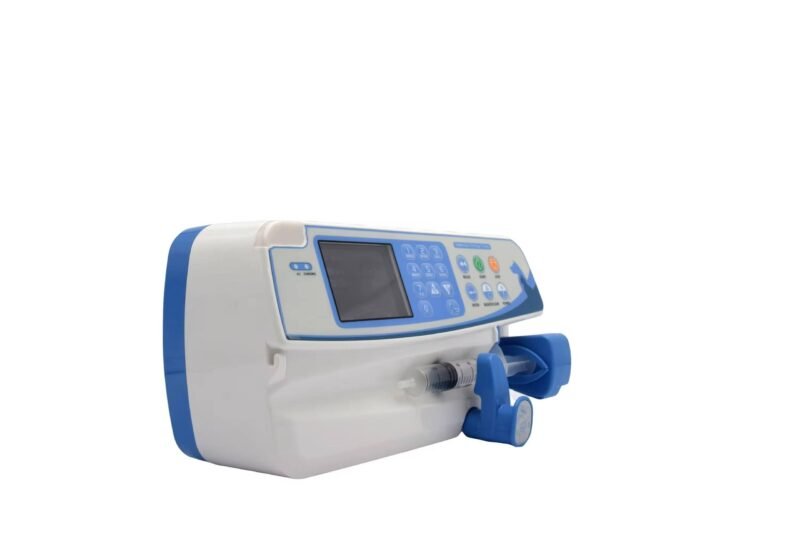
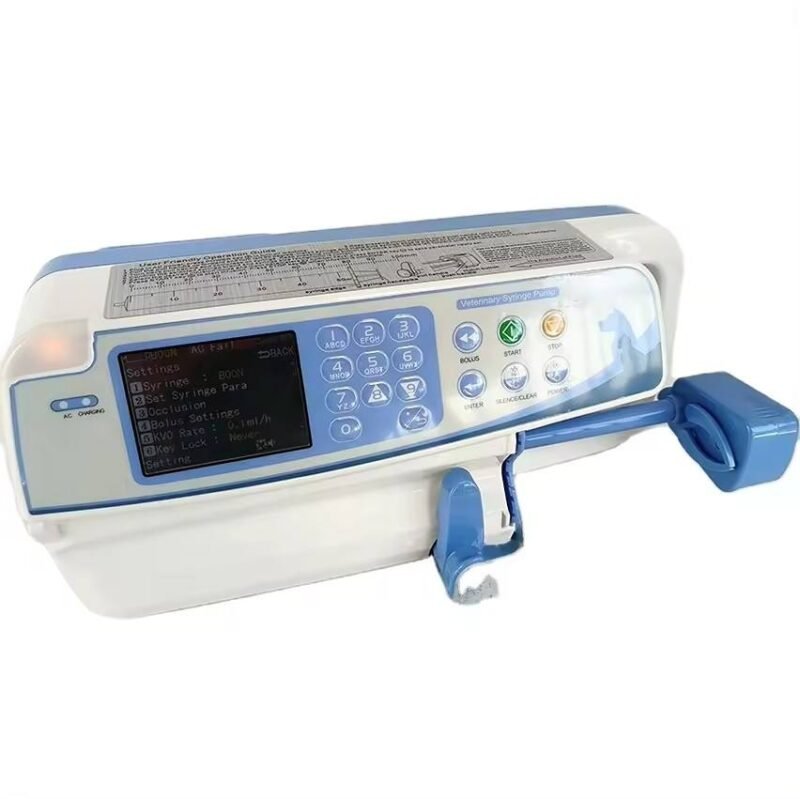
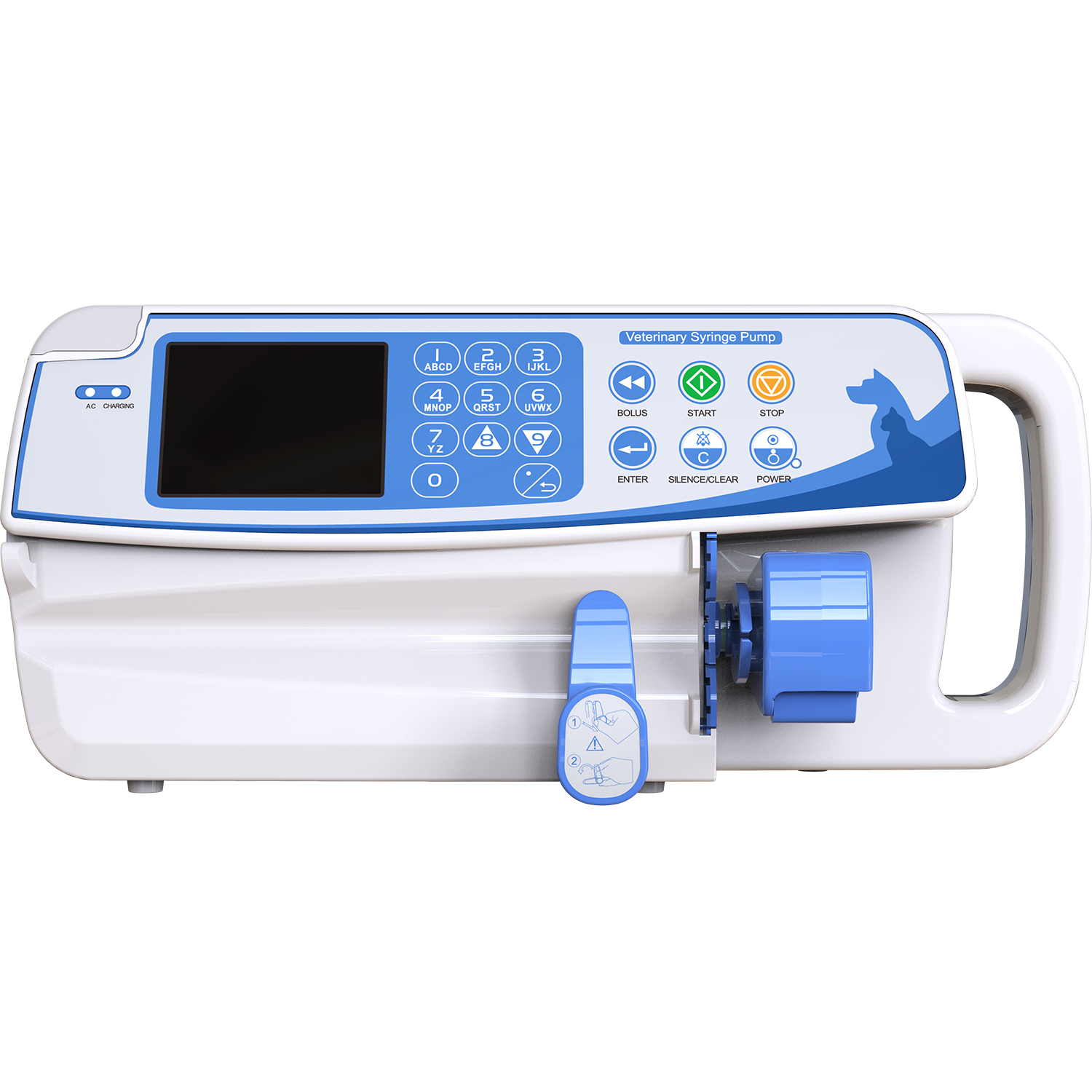
Veterinary syringe pump for precision micro-volume drug delivery and continuous-rate infusion in canine, feline, and small-animal patients.
Product Overview
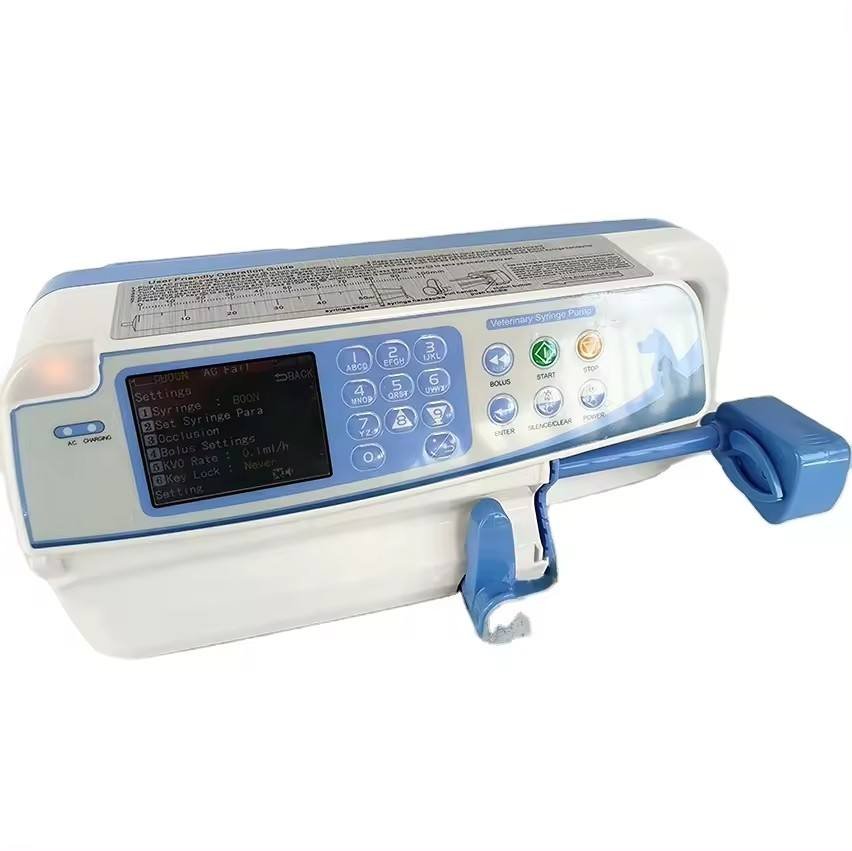
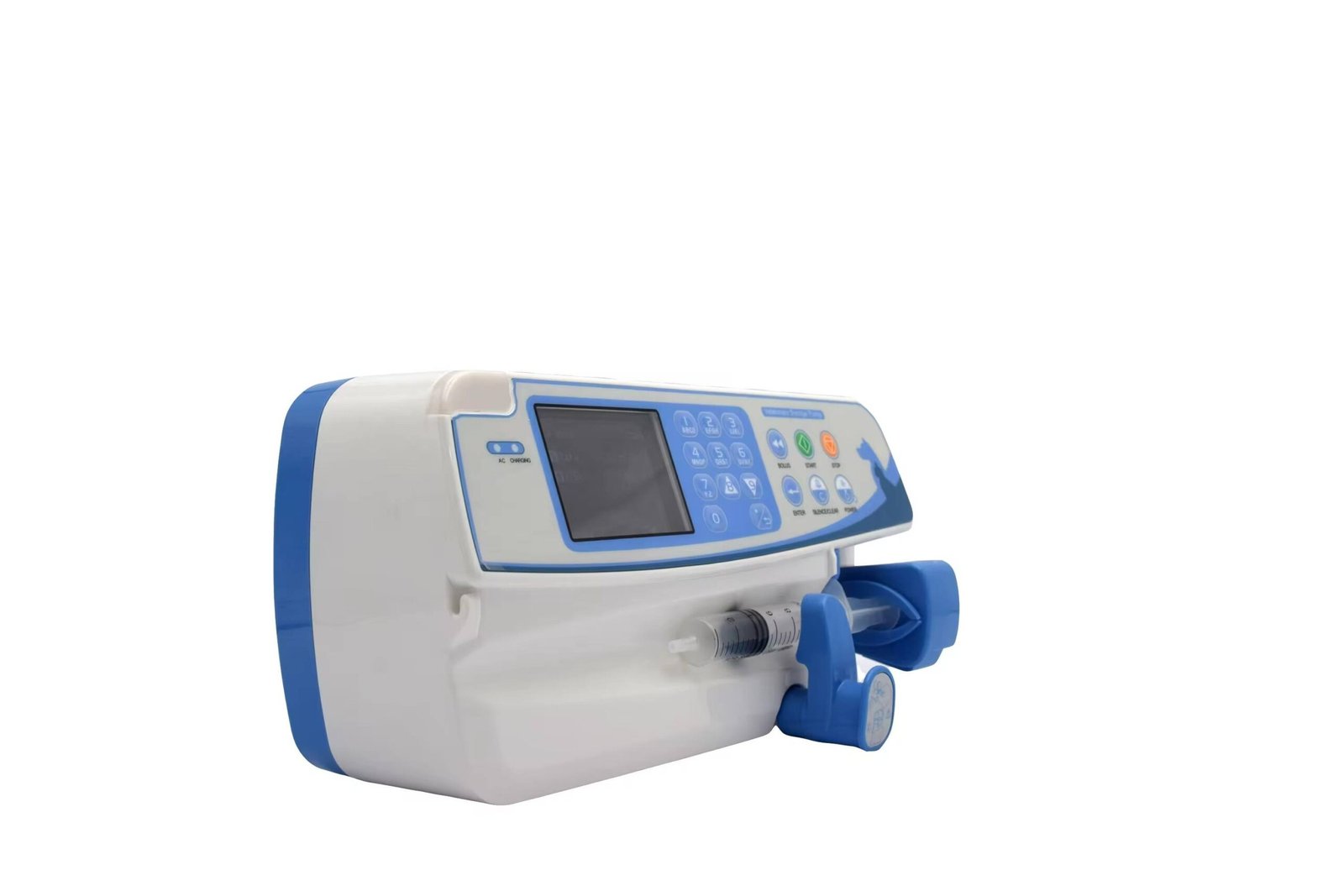
The LUMA-SP01 is a veterinary syringe pump engineered for accurate, low-volume drug delivery where the resolution of a drip-set or peristaltic pump is insufficient. It accepts any sterile syringe from 5 mL through 60 mL, delivers 0.1 – 1500 mL/hr depending on syringe size, and holds calibrated accuracy of ±2 % across the operating range.
Three independent occlusion-pressure levels, a comprehensive ten-condition alarm suite, anti-bolus on tubing disengagement, and a 7.4 V / 1900 mAh Li-polymer battery (~7 hours at 25 mL/hr) make the pump suitable for unattended CRI delivery, peri-operative analgesia, and inter-suite transport. Optional nurse-call and wireless-monitoring interfaces extend the device into multi-bed inpatient and ICU workflows.
Key Features
- 0.1 – 1500 mL/hr flow rate range scaled to syringe size: 5 mL (0.1–150) / 10 mL (0.1–300) / 20 mL (0.1–600) / 30 mL (0.1–900) / 50 mL or 60 mL (0.1–1500).
- ±2 % delivery accuracy after syringe calibration — sufficient for CRI of vasoactive drugs, opioid analgesia and anaesthesia top-ups.
- Five delivery modes — Rate, Time, Body-weight, plus optional Intermittent and Drug-library — selected from the front keypad without external software.
- Accepts any sterile syringe brand at the listed sizes; no proprietary disposables required.
- Three-level adjustable occlusion-pressure threshold (low / middle / high, 40 – 160 kPa) tunes alarm sensitivity to patient and circuit.
- Ten-condition alarm suite: syringe disengaged · almost done · infusion completion · empty · occlusion · low battery · handle off · AC fail · on battery · battery exhausted.
- BOLUS function with size-matched rate (5 mL: 100–150 mL/hr · 50/60 mL: 100–1500 mL/hr) for controlled push doses without leaving the running infusion.
- 1600 on-board history records for audit, shift hand-over and case review.
- Adjustable KVO rate 0.1 – 2 mL/hr (default 0.1) keeps the vein open between infusion stages.
- Built-in 7.4 V / 1900 mAh Li-polymer battery supports approximately 7 hours continuous at 25 mL/hr; full charge in 3 hours powered off, 10 hours powered on.
- Class I, type CF classification — direct-cardiac-application isolated patient connection.
- IPX3 splash protection, RS-232 computer interface, optional nurse-call and wireless monitoring interfaces.
Product Appearance
Technical Specifications
Flow & Delivery
| Compatible syringes | 5 / 10 / 20 / 30 / 50 / 60 mL — any sterile brand |
| Infusion rate (5 mL) | 0.1 – 150 mL/hr |
| Infusion rate (10 mL) | 0.1 – 300 mL/hr |
| Infusion rate (20 mL) | 0.1 – 600 mL/hr |
| Infusion rate (30 mL) | 0.1 – 900 mL/hr |
| Infusion rate (50/60 mL) | 0.1 – 1500 mL/hr |
| Accuracy | ± 2 % (after syringe calibration) |
| VTBI (volume to be infused) | 0 – 1000 mL |
| Volume infused counter | 0 – 9999.9 mL |
| KVO rate | 0.1 – 2 mL/hr (default 0.1) |
| BOLUS (5 mL) | 100 – 150 mL/hr |
| BOLUS (10 mL) | 100 – 300 mL/hr |
| BOLUS (20 mL) | 100 – 600 mL/hr |
| BOLUS (30 mL) | 100 – 900 mL/hr |
| BOLUS (50/60 mL) | 100 – 1500 mL/hr |
| Delivery modes | Rate · Time · Body-weight · Intermittent (opt) · Drug library (opt) |
Safety & Alarms
| Occlusion pressure | 40.0 – 160.0 kPa, 3 adjustable levels (low / middle / high) |
| Alarm conditions | Syringe disengaged · almost done · infusion completion · empty · occlusion · low battery · handle off · AC fail · on battery · battery exhausted |
| Classification | Class I, type CF |
| Ingress protection | IPX3 (splash from vertical, ≤ 60°) |
Power & Battery
| AC power | 100 – 240 V, 50 / 60 Hz |
| DC input | 12 ± 1.2 V |
| Power consumption | 25 VA |
| Battery | Li-polymer, 7.4 V / 1900 mAh, rechargeable |
| Operating time | ≈ 7 hours at 25 mL/hr |
| Charging time | 10 h with power on · 3 h with power off |
Physical
| Dimensions (L × W × H) | 300 × 130 × 125 mm |
| Net weight | 1.8 kg |
| Display | Colour TFT with status menu |
| Keypad | Alphanumeric for drug-name entry |
| Mounting | Integrated carry handle (optional pole clamp accessory) |
Connectivity
| Computer interface | RS-232 |
| Nurse-call interface | Optional |
| Wireless monitoring system | Optional |
| History records | 1600 entries on-board |
Environmental
| Operating temperature | 5 °C – 40 °C |
| Operating humidity | 10 % – 95 % RH |
| Operating pressure | 86 – 106 kPa |
| Transport temperature | -20 °C – 60 °C |
| Storage temperature | -20 °C – 45 °C |
Clinical Applications
Workflow & Installation Notes
- Syringe loading: open the thumb-grip retainer, seat the syringe flange into the carriage, close the retainer onto the plunger. The pump auto-detects syringe size from any of the six supported brands and prompts a confirmation on screen.
- Programming: select mode (Rate / Time / Body-weight / Intermittent / Drug-library), enter parameters via the alphanumeric keypad, press START. Use BOLUS for a controlled push at the size-matched rate without stopping the running infusion.
- Occlusion settings: set the three-level pressure threshold (low / middle / high) appropriate to the line and patient — neonates and small exotics typically use low; large-canine peripheral lines use middle or high.
- Power: mains AC 100–240 V universally; the pump switches to internal 7.4 V / 1900 mAh Li-polymer battery automatically for transport. DC 12 V input for vehicle and mobile setups.
- Battery management: keep on mains when stationary so the battery stays topped up. A 3-hour off-power or 10-hour on-power charge restores full capacity from empty.
- Cleaning: wipe the housing with a non-abrasive veterinary disinfectant. The IPX3 rating tolerates vertical splash; protect connectors and the syringe-carriage rail from fluid pooling.
- Integration: the RS-232 port supports computer logging; nurse-call and wireless-monitoring interfaces are available as factory options for multi-bed inpatient deployments.
Package Contents
- 1 × LUMA-SP01 veterinary syringe pump
- 1 × AC power cord
- 1 × Operator manual
Downloads & Documentation
Why Choose the LUMA-SP01
- Workflow efficiency. Accepts any sterile syringe from 5 to 60 mL — no proprietary disposables, no separate accessory packs by syringe size, no minimum-order lock-in.
- Clinical accuracy. ± 2 % calibrated accuracy plus three-level occlusion thresholds support pressor titration, opioid CRI and TIVA where dose-rate fidelity changes patient outcome.
- Practice economics. One pump platform covers neonatal microdosing (sub-mL/hr) through high-rate bolus delivery (1500 mL/hr) and replaces multiple single-purpose syringe drivers.
- Crash-cart and inter-suite ready. 1.8 kg with integrated carry handle and ~7 h battery; moves between OR, ICU, recovery and exam without re-installation.
Warranty & Support
LUMA-SP01 ships with a manufacturer warranty covering parts and labour for the duration specified at order confirmation. LumaVet provides operator training documentation and authorised service for the device. Contact us for a written quotation specific to your jurisdiction.
FAQ
- Do I need proprietary syringes?
- No. The LUMA-SP01 accepts any sterile syringe brand in 5, 10, 20, 30, 50 or 60 mL. The pump auto-detects size after calibration and applies the matching rate envelope. Practices keep their existing syringe supply contracts.
- What is the smallest infusion rate it supports?
- 0.1 mL/hr on any compatible syringe size, with KVO mode programmable from 0.1 to 2 mL/hr. This covers neonatal canine and feline patients, exotics and sub-1 kg cases where drip-set resolution is insufficient.
- How accurate is the delivery?
- ± 2 % after syringe calibration. The Class I type-CF classification permits direct-cardiac-application use, which makes the pump appropriate for vasoactive CRIs where dose-rate error directly affects haemodynamic response.
- How long does the battery last?
- Approximately 7 hours at a continuous 25 mL/hr maintenance rate from a full charge. Charge time is 3 hours with the pump powered off, 10 hours powered on. Keep the device on mains when stationary so battery stays topped up.
- What occlusion levels can I set?
- Three adjustable thresholds — low, middle, high — across a 40 – 160 kPa range. Use low for neonates and small-bore peripheral lines; middle for typical small-animal CRI; high for large-bore central lines where physiologic resistance is higher.
- Does it support integration with a clinic management system?
- The RS-232 computer interface supports local logging. Optional nurse-call and wireless-monitoring interfaces enable multi-bed monitoring and remote alarms. Specify these options at order placement.

Reviews
There are no reviews yet.