
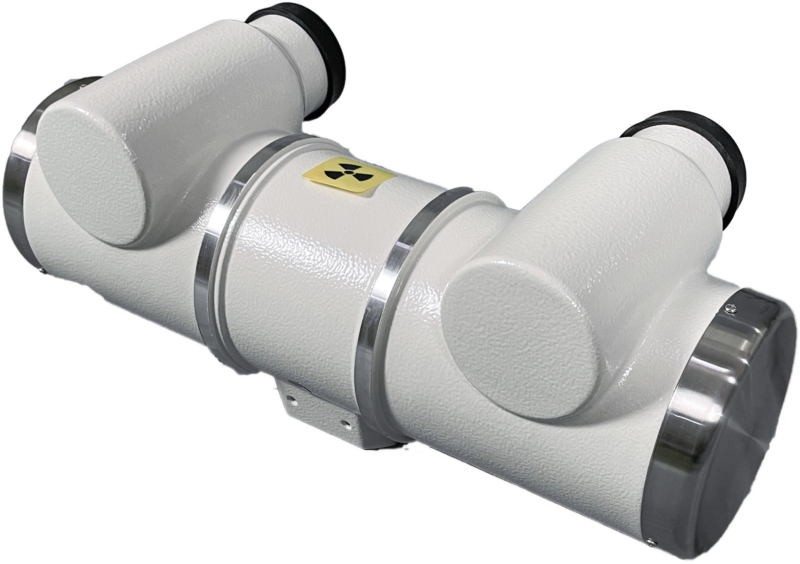
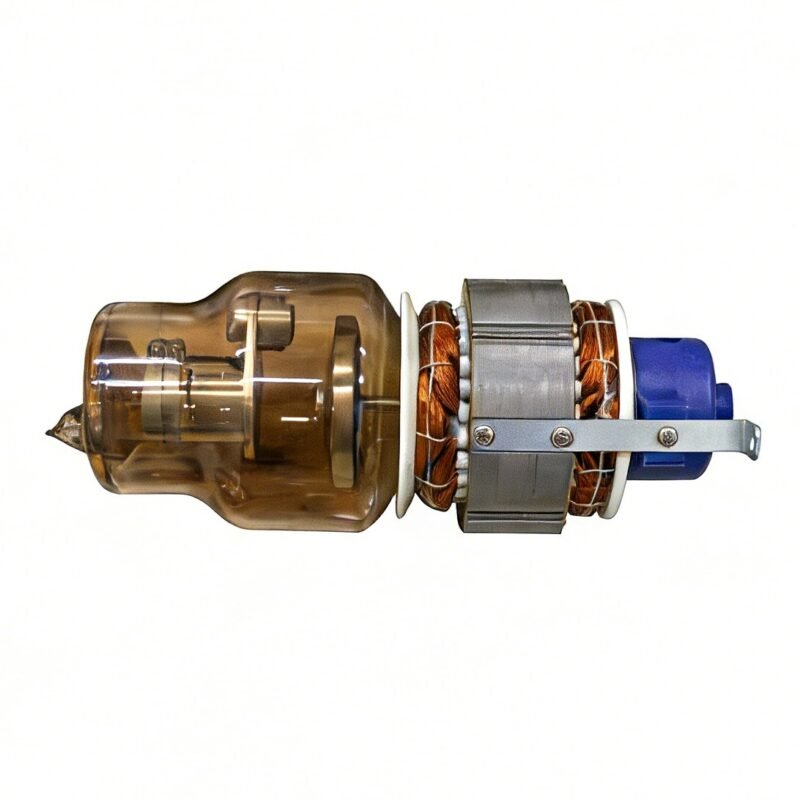
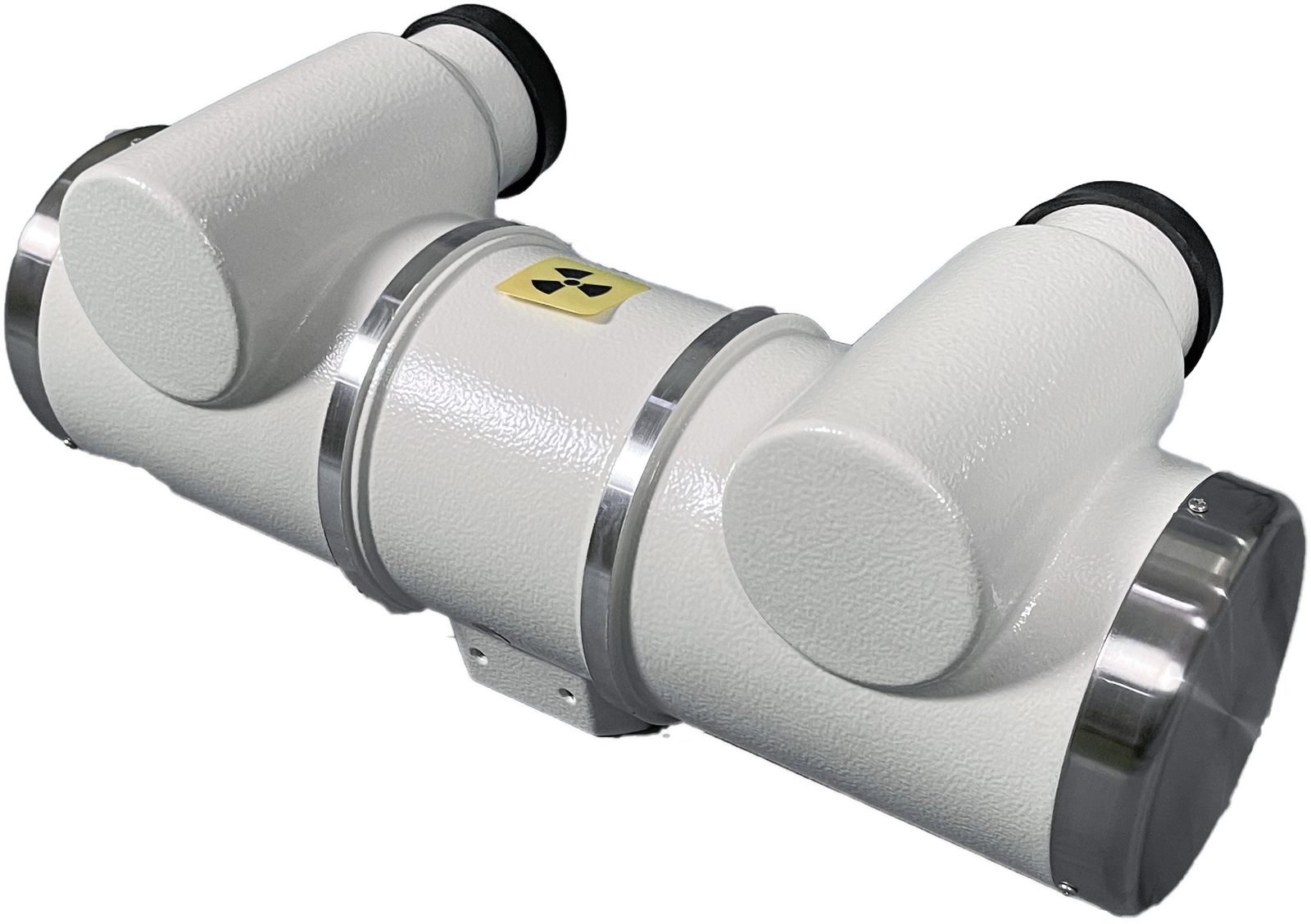
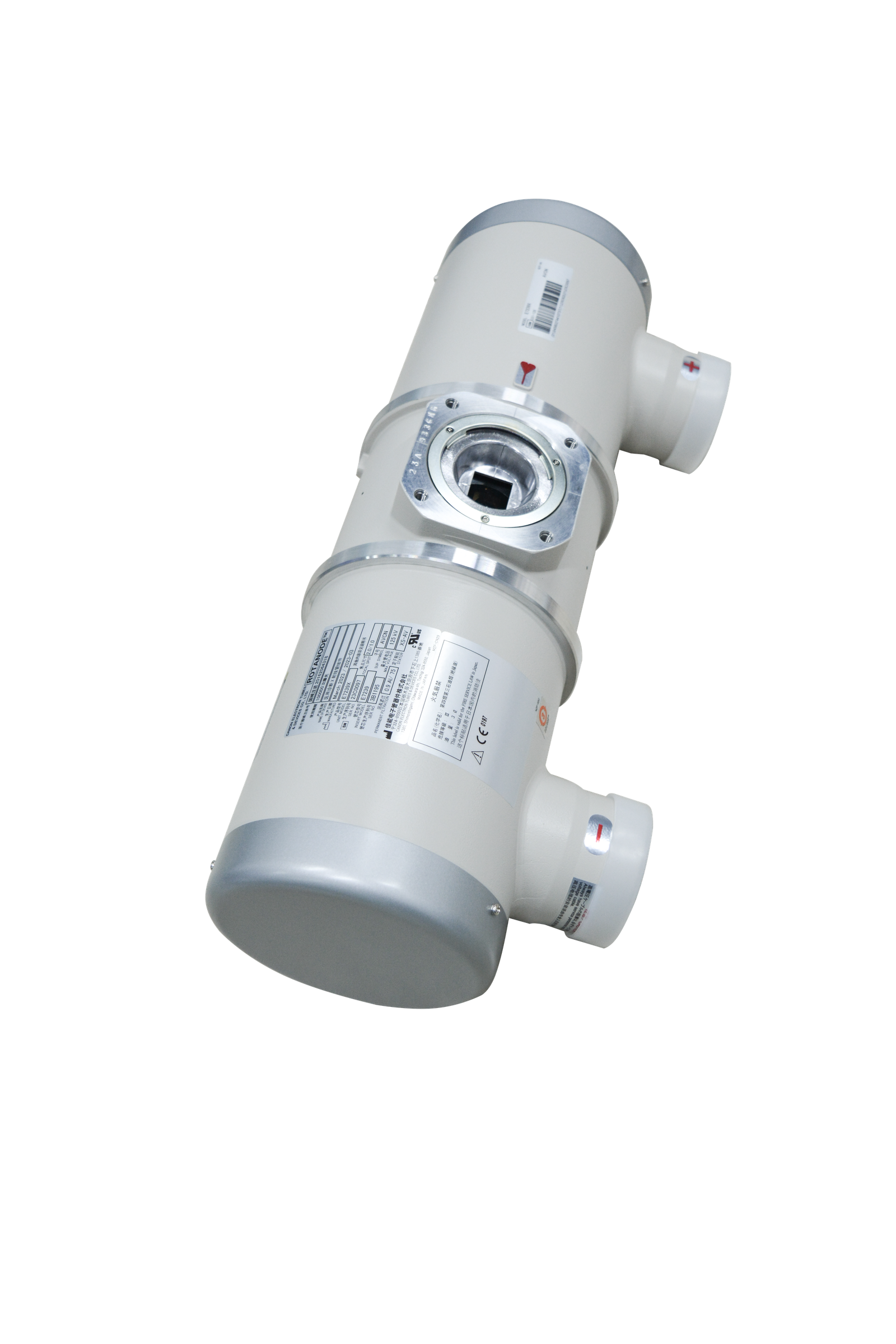
Rotating anode X-ray tube assembly LQ16-XD51-20.40/125 — 125 kV, 2.0 / 1.0 mm focal spots, 47 kW anode input.
Product Overview
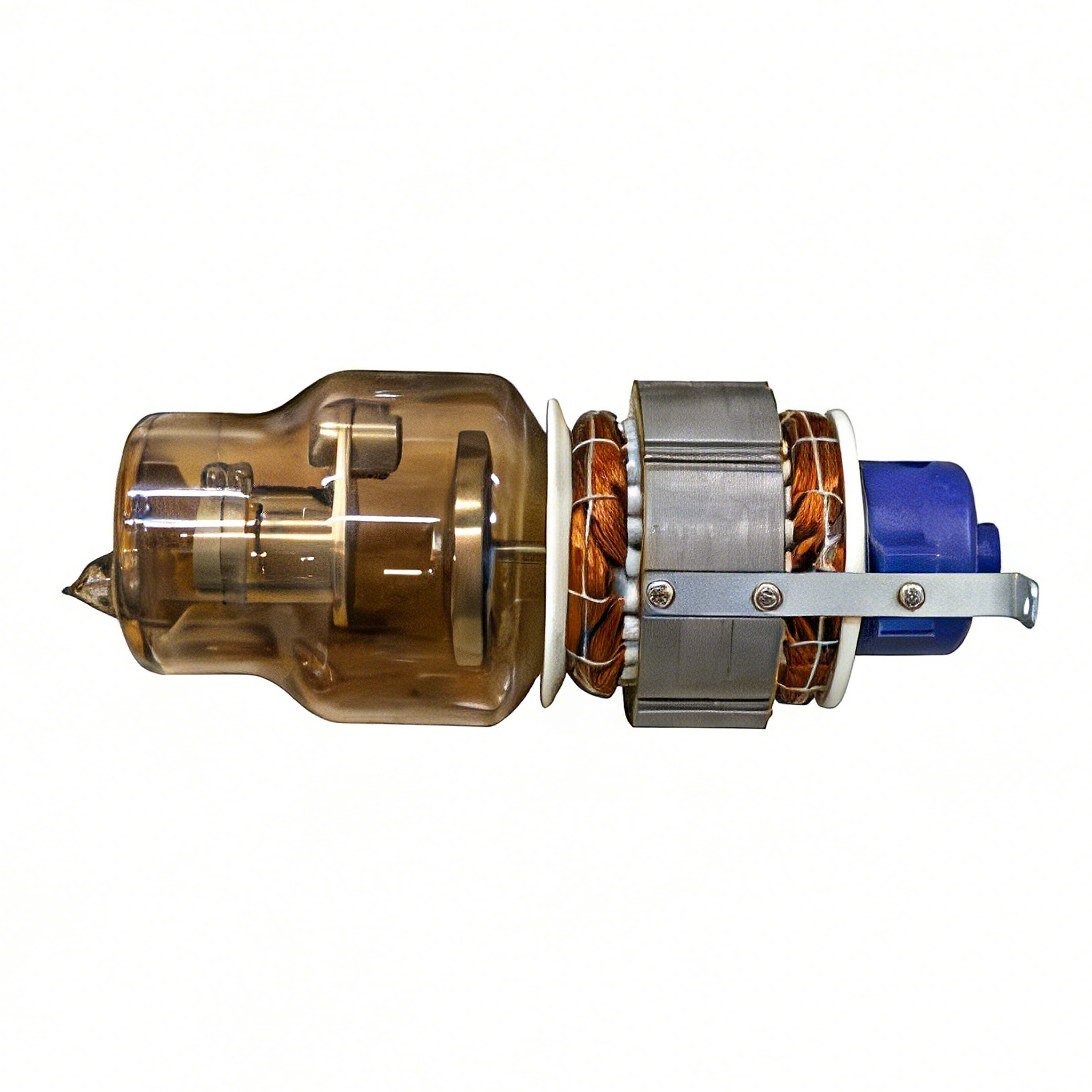
The LQ16-XD51-20.40/125 is a rotating anode X-ray tube assembly for general diagnostic radiography. The insert is an XD51-20.40/125 with a 70 mm pure-tungsten faced molybdenum target, 2.0 and 1.0 mm focal spots, and a 125 kV maximum tube voltage.
It is supplied as a replacement or build tube for veterinary radiography systems, with IEC 60526 high-voltage receptacles. At 480 mm overall length and 152.4 mm maximum diameter it shares the common housing envelope, and with forced air cooling it accepts 355 W continuous input.
Key Features
- Dual focal spots 2.0 and 1.0 mm — large focus for body work, small focus for extremity detail
- 47 kW large-focus anode input at 0.1 s (60 Hz); 22 kW small focus
- 70 mm pure-tungsten faced molybdenum target, 17.5° anode angle
- Anode heat content 110 kJ (150 kHU) with 475 W maximum dissipation
- Forced air cooling raises nominal continuous input from 180 W to 355 W (30 kHU/min) — roughly double the sustained throughput
- X-ray coverage 420 × 420 mm at SID 1000 mm — covers a 43 cm cassette at standard table distance
- Inherent filtration 1.0 mm Al, with a 1.5 mm Al additional filter set (3 × 0.5 mm)
- Leakage technique factors 125 kV, 3.0 mA
- IEC 60526 high-voltage receptacles
- Built-in safety thermal switch inhibits further exposure at the housing trip temperature
Visual Evidence
Technical Specifications
| Model | LQ16-XD51-20.40/125 |
| Insert | XD51-20.40/125 |
| Type | Rotating anode X-ray tube assembly, general diagnostic radiography |
| IEC classification | Class I, Type B |
| Nominal X-ray tube voltage | 125 kV radiographic |
| Minimum tube voltage | 40 kV |
| Maximum anode (or cathode) to ground | 65 kV |
| Nominal focal spot values | Large 2.0 mm / small 1.0 mm |
| Nominal anode input power (0.1 s) | Large focus 40 kW at 50 Hz, 47 kW at 60 Hz; small focus 20 kW at 50 Hz, 22 kW at 60 Hz |
| Maximum filament current | 5.5 A, both foci |
| Filament voltage at 5.5 A | Large focus 10–13 V; small focus 7–9 V |
| Filament frequency limits | 0–25 kHz |
| Target | Pure tungsten faced molybdenum, 70 mm diameter, anode angle 17.5° |
| Anode speed | 2800 rpm at 50 Hz; 3200 rpm at 60 Hz |
| Motor rating | Starting 160 V / 3.5–5.5 A, speed-up 1–1.2 s; running 60 V / 1.0–1.5 A; capacitor 43/30 µF |
| Stator impedance | Common–main 20.0 Ω; common–auxiliary 50.0 Ω |
| Housing to low-voltage terminal resistance | Minimum 2 MΩ |
| Anode heat content | 110 kJ (150 kHU) |
| Maximum anode heat dissipation | 475 W (667 HU/s) |
| Tube assembly heat content | 900 kJ (1250 kHU) |
| Nominal continuous input power | 180 W (15 kHU/min) without air circulator; 355 W (30 kHU/min) with air circulator |
| Inherent filtration | 1.0 mm Al equivalent |
| Additional filtration | 1.5 mm Al (3 × 0.5 mm) |
| Leakage technique factors | 125 kV, 3.0 mA |
| X-ray coverage | 420 × 420 mm at SID 1000 mm |
| High-voltage receptacle | IEC 60526 |
| Cooling | Natural or forced air |
| Housing temperature, normal operating range | 16–75 °C |
| Overall length | 480 mm |
| Maximum diameter | 152.4 mm |
| Weight | About 17 kg |
| Operating environment | +10 to +40 °C, relative humidity ≤75%, 70.0–106.0 kPa |
| Transport and storage | −20 to +55 °C, relative humidity 20–90%, 50.0–106.0 kPa |
Clinical Applications
- General veterinary radiography — thorax, abdomen, spine and pelvis on large focus
- Extremity and skull detail on small focus
- Table-top radiography at SID 1000 mm, where the 420 × 420 mm coverage takes a 43 cm cassette
- Replacement tube for veterinary radiography systems using the standard 152.4 mm housing envelope
- High-throughput lists, where forced air cooling doubles sustained input to 355 W
Installation & Service Notes
- Confirm the generator can drive the stator: starting 160 V at 3.5–5.5 A, running 60 V, capacitor 43/30 µF. Speed-up takes 1–1.2 s
- Load the tube data into the generator after fitting — heat storage 900 kJ, large focus 47 kW, small focus 22 kW. A generator still holding the previous tube’s data will either refuse exposures or over-drive the new tube
- Hook the housing thermal switch to the generator. When the switch opens, leave system power on so the cooling unit keeps running
- High-voltage plugs must be clean and undamaged; apply silicone compound before insertion
- The insert is glass. Mechanical shock above 19.6 m/s² (2 G) can break it
- Connect the ground terminal, and fit beam-limiting equipment on the X-ray port
- Housing is lead-lined and oil-filled — dispose of a failed assembly through the appropriate regulated route
Package Contents
Downloads & Documentation
Why Choose This Tube
- Forced air cooling lifts sustained input from 180 W to 355 W — the difference between stopping mid-list and finishing it
- 420 × 420 mm coverage at SID 1000 mm takes a full 43 cm cassette without repositioning the tube
- Standard 152.4 mm housing envelope and IEC 60526 receptacles keep it a straight swap on most systems
- Full manufacturer rating data on file — heat content, stator ratings and load curves can be matched to the generator before ordering
Warranty & Support
FAQ
Will it fit my existing system? The envelope is 480 mm long and 152.4 mm maximum diameter with IEC 60526 receptacles, which is the common fit. The generator must drive the stator at 160 V starting, 60 V running, with a 43/30 µF capacitor. Send us the tube being replaced and we will confirm.
How does it compare with the Canon E7239X? Both are 125 kV assemblies with 2.0 / 1.0 focal spots and comparable large-focus input. The E7239X uses a rhenium-tungsten faced target at 74 mm and 16°; this tube uses a pure-tungsten faced target at 70 mm and 17.5°, and offers a higher continuous rating with forced air. Ask us which suits your workload and budget.
Does forced air cooling matter? It raises nominal continuous input from 180 W (15 kHU/min) to 355 W (30 kHU/min). On a busy list that is the difference between a cooling pause and continuous work.
Does the generator need reconfiguring after fitting? Yes. Tube data must be reloaded — heat storage and the per-focus kW limits. Skipping this step is the most common cause of a new tube failing early.
Is a collimator required? Yes. Beam-limiting equipment must be mounted on the X-ray port. We supply collimators separately.
Reviews
There are no reviews yet.